For a few years now I’ve been doing all manner of design work for locally based, world-reknowned luthier Jamie Wiens. Jamie builds replicas of 20’s era Gibson Master Model F-5 mandolins.
Illustration for Jamie Wiens shirts
Jamie has a very particular way of accomplishing things. It has to be perfect, but not perfect as in unblemished, perfect as in faithful reproduction. While many builders are going the way of lacquers, ebony veneers, and modern hardware, Jamie is trying to get back to the true instrument. This means building blemishes, imperfections, and simplifying the wood selection to line up with the vintage instruments. For instance, while many builders use ebony for the peg-head veneer (at the top, where the strings attach) Jamie discovered that the original instruments used pearwood dyed with india ink. This set him off on a journey that lead to re-discovering a process used by Lloyd Loar, the chief acoustic engineer at Gibson at that time. It’s a lot of work, but the work pays off. Have a look at some of his instruments at Jamie’s website.
I first got started working with Jamie because he wanted to produce labels for his mandolins using the era-appropriate process, and I happen to have a letterpress and a polymer-plate maker in the garage. This began a long career as designer of his website, business cards, hang-tags, shirts, and even some fun work for custom inlays.
The F-5 mandolin is heavily influenced by the Art Nouveau designs that were arriving (a bit late) in America. By 1910 the Nouveau look had come and gone in most of europe, but was still evolving and influencing artists stateside. Evolving from the round-backed European mandolins, the first carved-top, flat-backed mandolins are credited to Orville Gibson, founder of Gibson (obviously). By the time 1920 rolled around, the F (for florentine) 5 model had solidified into an oval-shaped body, with a nouveau-inspired scroll on the top above the fret-board, and a small point below. The headstock has embellishments that emphasize the nouveau look. The Art Nouveau period has always been a fascinating one for me as it worked traditional mediums (wood & steel) into natural, lithe shapes that looked organic. I had always wanted to attempt a design in that style, but needed a bit of motivation.
A couple of years ago I had this idea to do a t-shirt design for Jamie that he could send along to his clients with a new mandolin, and it occurred to me that creating an Art Nouveau poster styled image with the mandolin would be a beautiful combination. I chose a nice big piece of paper, and a very fine pen, and set out to do just that. A year and a bit later I had finally finished the drawing with impressive results. Unfortunately the whole thing was too large for a shirt, so I had to reduce it, which with the fine lines and cross-hatching, did not translate well to a silk-screen. We did one test shirt and then I realized that I had to go back to the ‘drawing board’ and re-do the drawing. It was smaller, and I had a thicker pen, so it took less time, and three months later here is the finished product ready to go to press. I’ll post some photos of the finished shirts once they are done.
5 thoughts on “Old Meets Nouveau”
Beautiful sketch Mike. The cross hatching textured background, however you might describe it is one of your trademarks!

 michael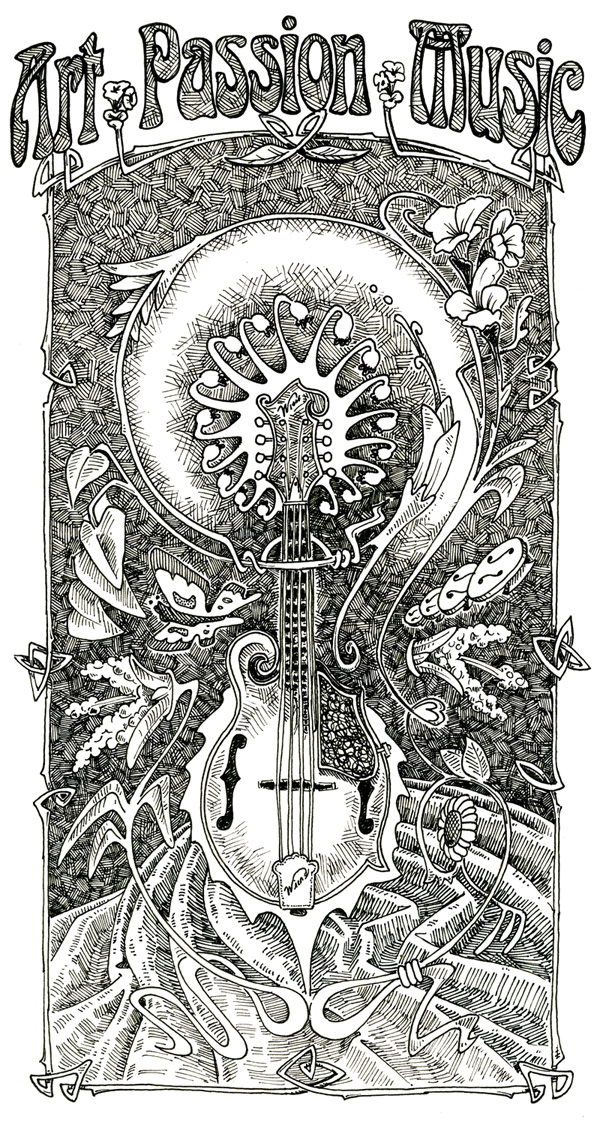


Beautiful sketch Mike. The cross hatching textured background, however you might describe it is one of your trademarks!
Thanks Mark, yeah guess you’re right that I’ve evolved my own shading style over the years. I think I’ve used it since Jr. high or so.
Hello!
I’m Matt Thomas from Roanoke, Va. Your Weins t-shirt is very nice. Do you have large or medium in stock for sale?
Best Regards,
Matt
Hello Matt, you’ll have to check with Jamie at http://www.weinsmandolins.com for a shirt. I just did the drawing. Cheers, –mike